Watch the Image Change Its Mind
Not a pixel moves, yet the cube turns inside out and the vase becomes two faces. The rule: when an image fits two interpretations equally well, perception picks one, holds it briefly, then switches. It never shows you both at once.
The cube that turns itself inside out
In 1832 the Swiss crystallographer Louis Albert Necker noticed that his drawings of rhombohedral crystals seemed to reverse while he studied them. A plain wireframe cube does the same: either the lower-left face is in front, or the upper-right is. Both readings are geometrically valid, which is exactly what separates the Necker cube from impossible figures. It has too many solutions, not too few.
Psychologists call this bistable perception. Your visual system cannot settle on depth without shading, overlap or perspective, so it adopts one hypothesis and, after a few seconds, adapts to it and tries the other. You can steer the switch: fix your gaze on one corner and that corner tends to jump forward.
- Remove every depth cue except line junctions.
- Keep both readings equally plausible.
- Let attention decide which one wins.
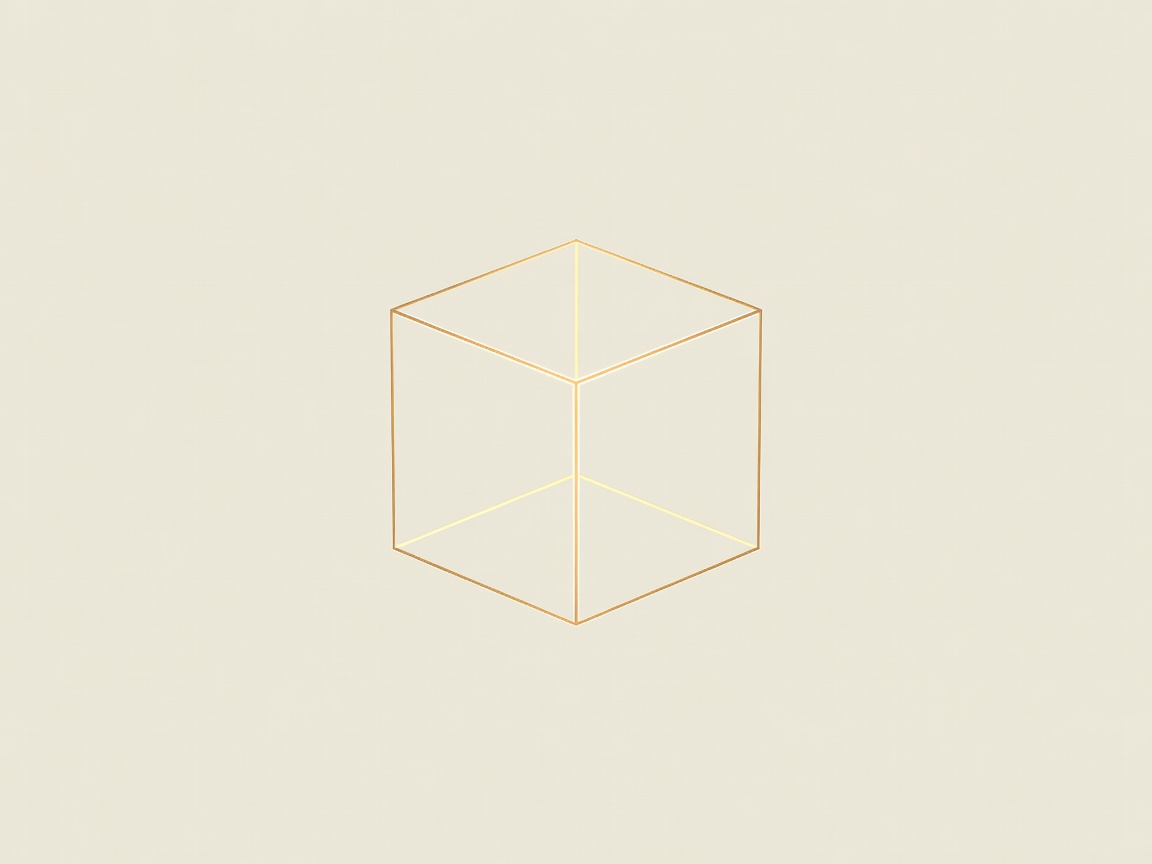
Flat, even lighting removes shading hints. Fix your eyes on the top-right corner, then on the bottom-left, and notice the cube reverse.
Figure, ground and the borrowed edge
Danish psychologist Edgar Rubin published his study of figure and ground in 1915, and the vase-and-faces image that carries his name has been redrawn countless times since. The trick hides in one contour: a single edge can belong to only one side at a time. When it belongs to the vase, the dark areas become empty background. When it belongs to the faces, the vase dissolves into the gap between two profiles.
The duck-rabbit works differently. First printed in the German humour magazine Fliegende Blätter in 1892, then used by psychologist Joseph Jastrow in 1899 and later by philosopher Ludwig Wittgenstein, it keeps the same figure but changes what the parts mean. The duck’s bill becomes the rabbit’s ears. The outline stays, but the story behind it switches.
Gestalt psychologists treated such images as evidence that we see organised wholes, not loose collections of lines.
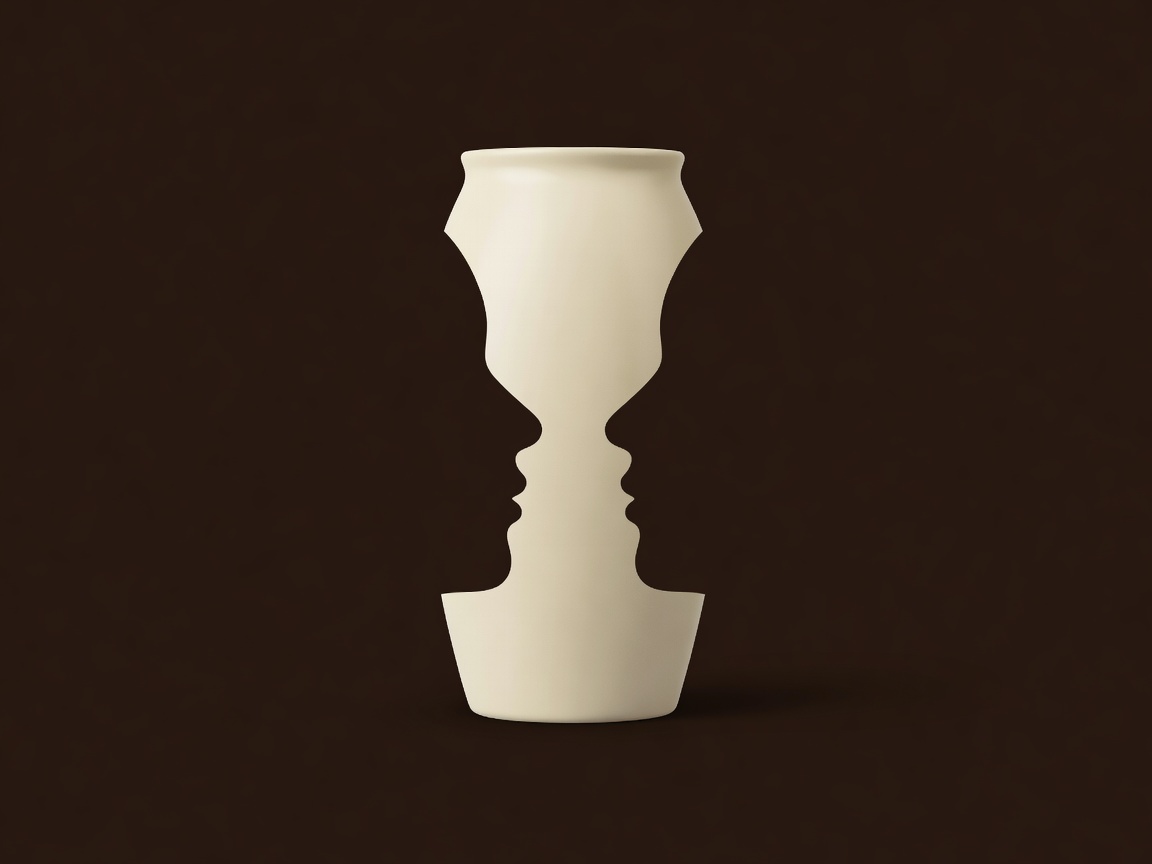
A real vase lathed so its silhouette traces two profiles. The shadow-free background lets either the vase or the faces become the figure.
Light from above, and lines that refuse to stay straight
Turn a photo of dimples upside down and they often become bumps. Your visual system assumes light comes from above, so a circle darker at the top reads as a hollow and darker at the bottom reads as a dome. Nothing in the picture says which is true; your assumption fills the gap.
Patterns can mislead orientation as well as depth. In the café wall illusion, described by Richard Gregory and Priscilla Heard in 1979 after a tiled café wall in Bristol, rows of offset dark and light bricks with thin grey mortar lines make perfectly parallel rows appear to wedge and tilt. Lay a ruler along the mortar and the slope vanishes.
A note on comfort: some striped and high-contrast patterns cause visual discomfort, and flashing patterns can trigger seizures in people with photosensitive epilepsy. We present still images only, with moderate contrast.
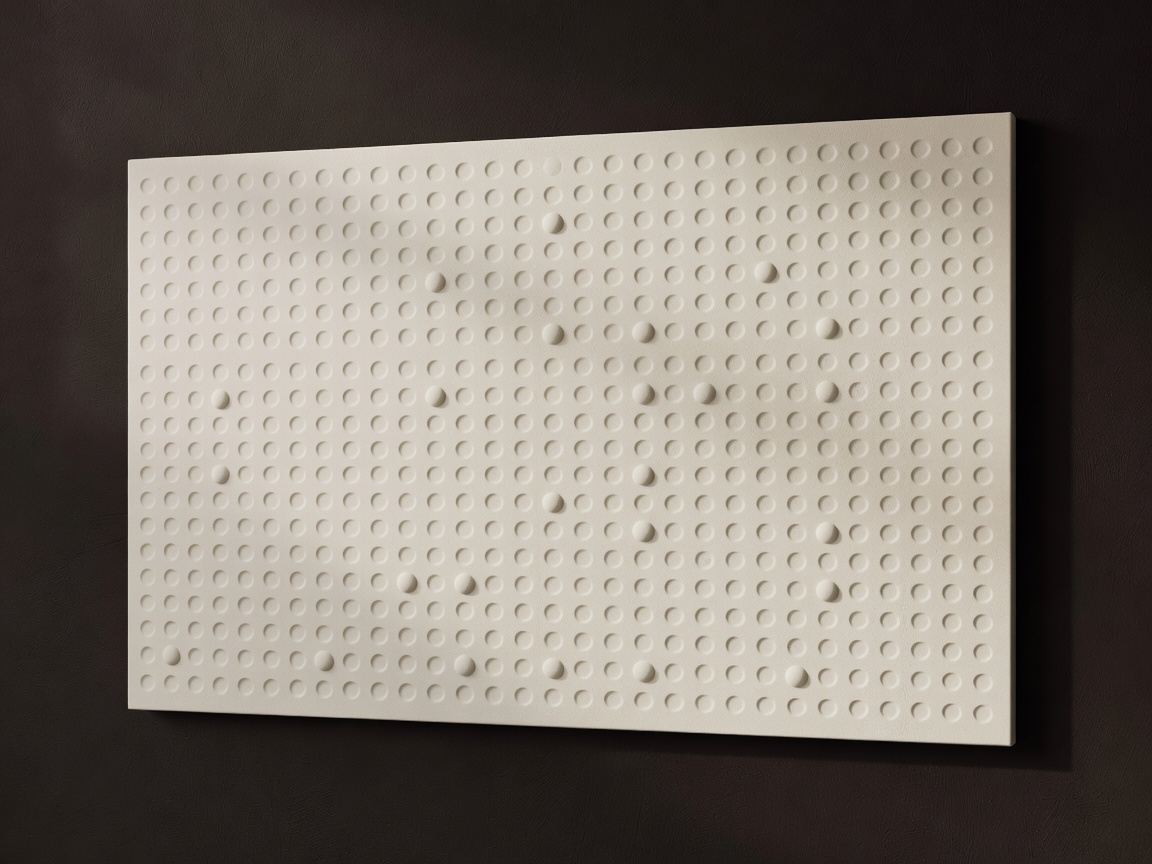
Rows of hollows and domes lit from one side. Rotate your screen 180° and most viewers see the two kinds swap places.
Construction notes
Draw your own ambiguous cube
Draw two equal overlapping squares, offset diagonally. Join matching corners. Use the same line weight everywhere and avoid breaking any line where it passes “behind” another. Any hint of which line is hidden decides the cube for the viewer.
Design a figure-ground reversal
Draw a profile on the left edge of a sheet, mirror it on the right, and fill the space between with a single colour. Adjust the profile curves until the shape between them reads as a plausible object: a vase, a candlestick, a chess piece.
Test the light-from-above bias
Photograph an egg carton lit from a desk lamp above. View the image normally, then upside down, and note which cups read as hollow.