Discover the Rule Inside the Repeat
A rigid repeat should feel still. Instead, it produces stars nobody drew, ripples across a flat wall and grids that seem to breathe. The rule: four symmetry moves, combined in a strictly limited number of ways.
Four moves, seventeen groups
Every flat repeating pattern is built from a motif and a set of moves that carry it onto copies of itself: translation (slide), rotation (turn), reflection (mirror) and glide reflection (mirror and slide together). Rotations in a repeating pattern are restricted to half, third, quarter and sixth turns; a five-fold turn cannot repeat across a flat plane.
Combine those moves every way they can coexist and you get exactly seventeen distinct pattern types, the wallpaper groups. Russian crystallographer Evgraf Fedorov proved this in 1891, and George Pólya brought it to wider attention in 1924. Escher studied Pólya’s paper closely.
The Alhambra in Granada is often cited as containing examples of many, perhaps all, seventeen groups. Scholars still debate the exact count, which is a good reminder to check a pattern’s symmetry yourself rather than trust a label.
- Find the smallest tile that repeats by sliding alone.
- Look for centres of rotation and count the turn.
- Look for mirror lines, then for glides.
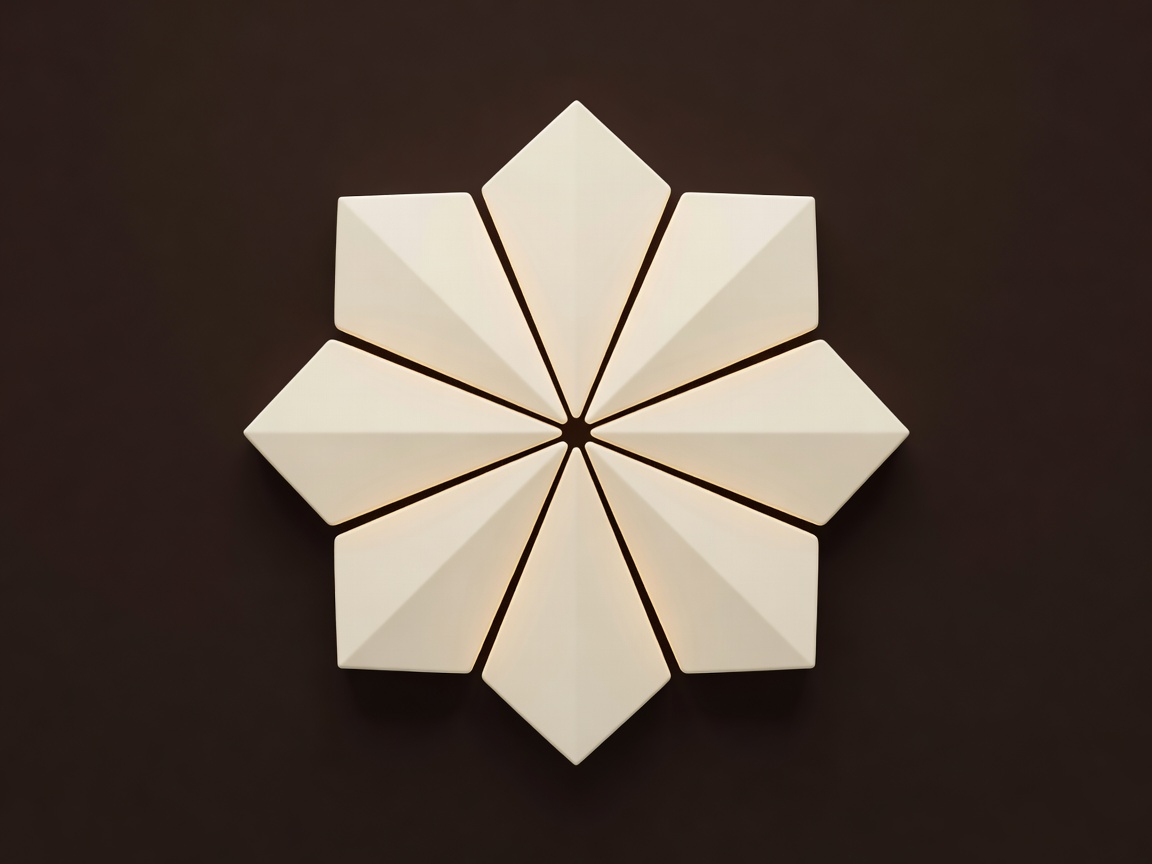
Six identical blocks, each rotated 60° from the last. Remove the colour and the mirror lines through each petal become visible too.
Girih: stars from a hidden tile set
Medieval Islamic architecture is famous for interlacing star-and-polygon patterns, called girih. For a long time historians assumed craftsmen drew them directly with compass and straightedge. In 2007 physicists Peter Lu and Paul Steinhardt argued in the journal Science that many were built from a small set of decorated tiles: a decagon, pentagon, bowtie, rhombus and elongated hexagon.
The lines painted on each tile join up across edges, so the visible pattern hides the tiles that produce it. On the Darb-i Imam shrine in Isfahan, completed in 1453, they identified patterns that come close to Penrose-style quasicrystalline order, centuries before mathematicians described it.
This is the pattern version of an illusion: the obvious shapes are the stars, while the structure is a set of quieter polygons you never see.
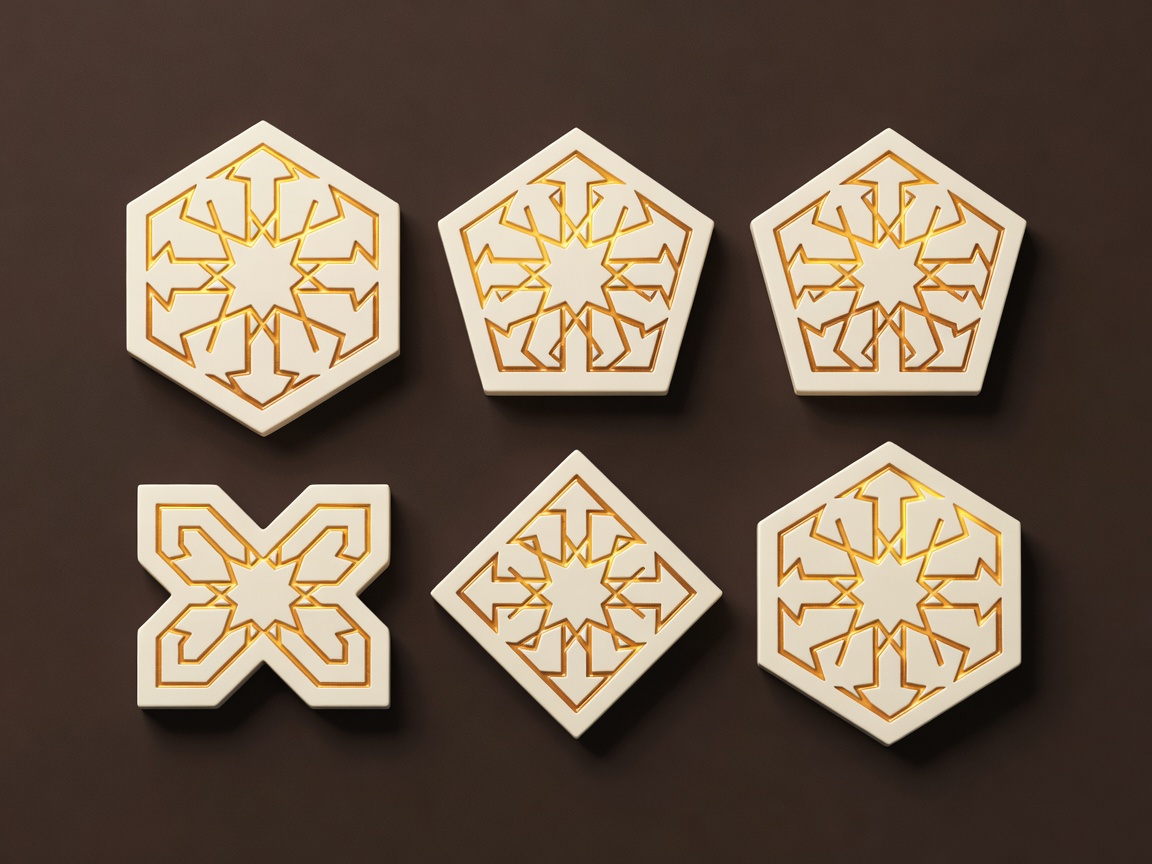
The five girih shapes. Amber lines cross each edge at its midpoint, so any legal arrangement produces a continuous interlace.
When stillness starts to move: Op Art
In the 1960s, Op Art pushed repetition until the eye could no longer hold the pattern steady. Victor Vasarely swelled and compressed grids so flat canvases seemed to bulge. Bridget Riley’s black-and-white works, such as Movement in Squares (1961), narrowed a row of squares until the surface appeared to fold. The Museum of Modern Art in New York gathered the movement in its 1965 exhibition The Responsive Eye.
The rule here is gradual change inside a repeat. Keep the motif constant but vary its size, spacing or angle step by step, and your visual system reads the gradient as depth or motion. Owen Jones’ The Grammar of Ornament (1856) catalogued historic repeats; Op Art asked what happens when the grammar is stretched.
We show these ideas with gentle, low-contrast relief renders instead of reproducing high-contrast striped artworks, which can be uncomfortable for some viewers.
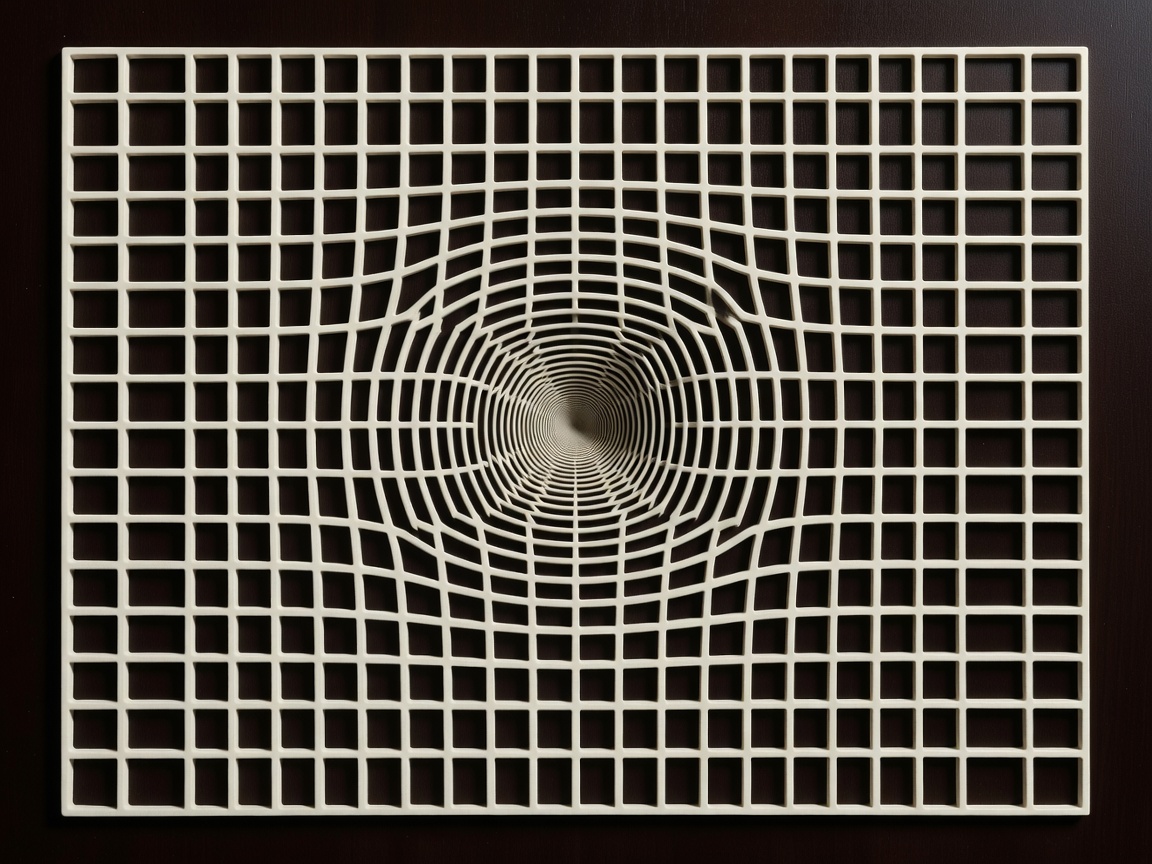
One square, scaled down in steady steps. The surface is flat; the swelling is the gradient.
Construction notes
Draw a six-fold rosette with a compass
- Draw a circle.
- Keep the same compass width and step it around the edge, marking six points.
- Draw a circle from each point.
- The overlapping arcs form a six-petal rosette; extend the grid to make a repeating pattern.
Identify a wallpaper group in a tiled floor
Mark one motif. Find the smallest parallelogram that repeats by sliding. Then check: highest rotation? Mirrors present? Glides between mirrors? Those three answers narrow seventeen candidates to one.
Make a calm gradient pattern
Choose a circle motif in a square grid. Shrink each row by 8% toward the centre line and grow it again beyond. Keep contrast moderate to avoid shimmer.