Let One Tile Fill the Plane
An endless floor built from one finite shape, with no gaps, no overlaps and, in a few remarkable cases, no repeat at all. It sounds like a riddle. The rule that answers it fits in one line: the angles at every corner must add up to 360°.
Why only three regular tiles work
Stand at any point where tiles meet. The corners gathered around that point must close a full turn, no more and no less. For a regular polygon, every corner is the same, so the question becomes simple arithmetic: does 360 divide evenly by the interior angle?
An equilateral triangle has 60° corners, so six meet. A square has 90°, so four meet. A regular hexagon has 120°, so three meet. The regular pentagon, at 108°, leaves a stubborn 36° gap with three tiles and overlaps with four. Heptagons and beyond have corners larger than 120°, so even three of them overshoot the turn. That leaves exactly three regular tessellations, which is why bathroom floors and honeycombs look so familiar.
Allow two or more regular polygons and insist that every vertex looks the same, and you get eight more: the semiregular, or Archimedean, tilings. Johannes Kepler set them out in Harmonices Mundi in 1619, combining octagons with squares, hexagons with triangles, and dodecagons with both.
- Sum the angles meeting at a vertex.
- It must equal 360° exactly.
- Check that edges line up, not just corners.
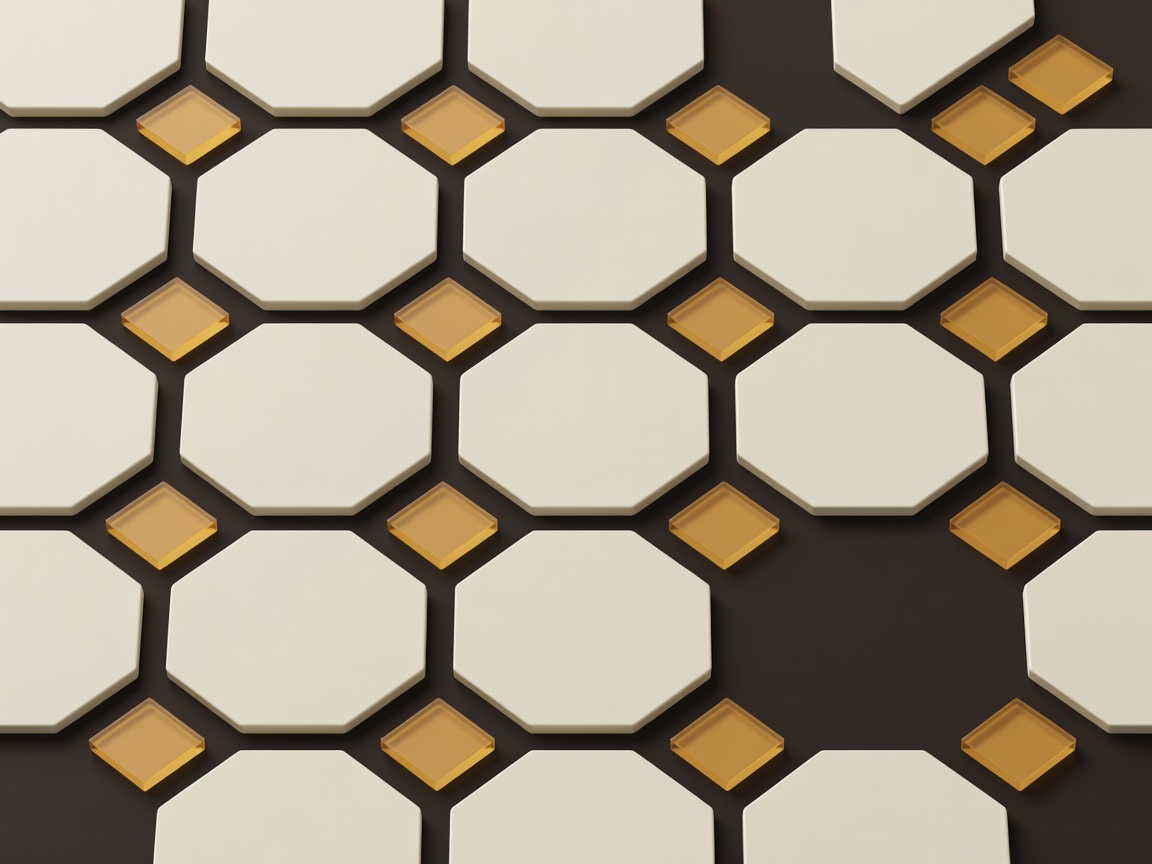
The truncated square tiling: two octagons and one square at every vertex. 135° + 135° + 90° = 360°.
Pentagons: the shape that kept surprising experts
The regular pentagon fails, but bend its sides and angles and the story changes. Some irregular convex pentagons tile perfectly, and finding them all turned into a century-long hunt.
German mathematician Karl Reinhardt described five families in 1918. Decades later, after reading Martin Gardner’s column in Scientific American, Marjorie Rice, a San Diego homemaker without formal mathematical training, invented her own notation and discovered four new types in the 1970s. In 2015 Casey Mann, Jennifer McLoud-Mann and David Von Derau at the University of Washington Bothell found a fifteenth type using a computer search. In 2017 Michaël Rao published a computer-assisted proof that the list of fifteen is complete.
The lesson for makers: the 360° rule still governs, but irregular shapes can meet in mixed groups, two angles here and three there, as long as each vertex closes.
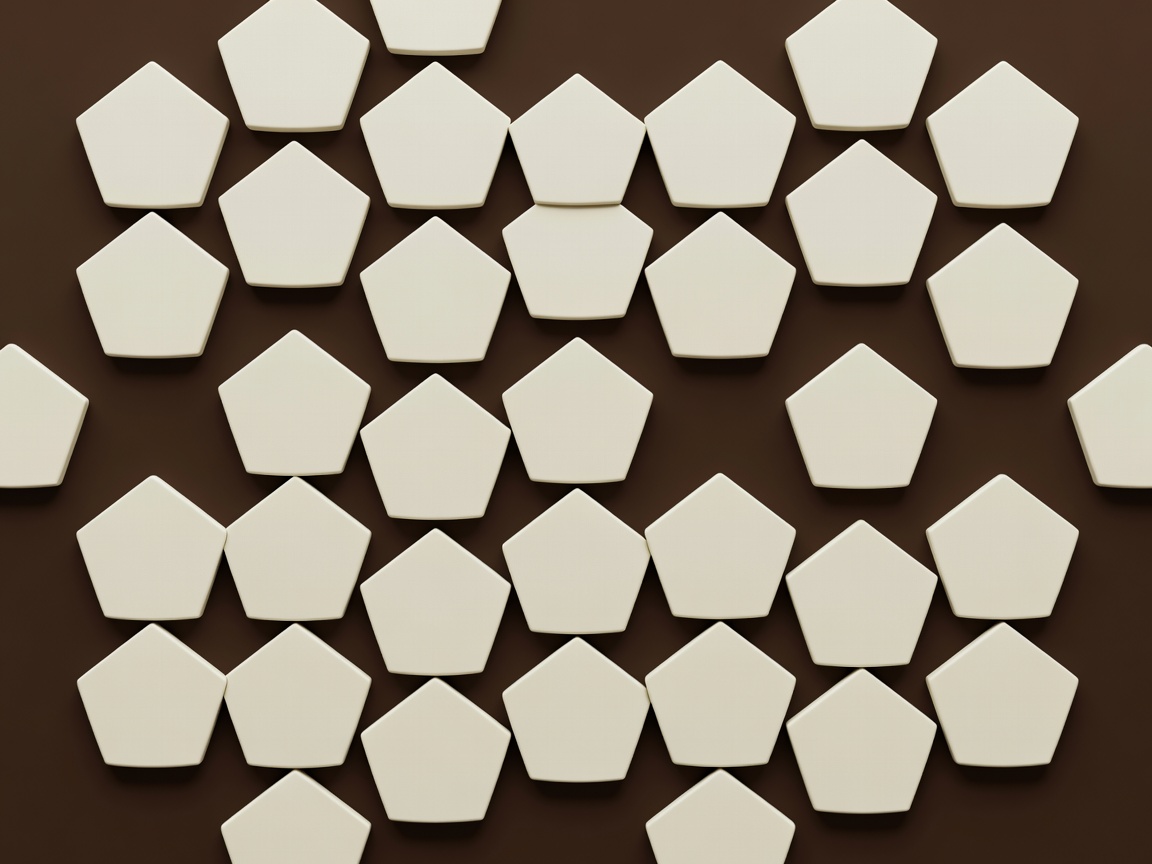
An irregular convex pentagon in a tiling arrangement. Some vertices gather three tiles, others four, yet every vertex closes at 360°.
From Escher’s creatures to tiles that never repeat
M.C. Escher studied the tilework of the Alhambra in Granada during visits in 1922 and 1936, then spent decades turning polygons into birds, fish and lizards. His core move is easy to learn: whatever you cut out of one edge, you add to the opposite edge, so the tile still slides into its neighbours. We describe his works here rather than reproduce them; they remain under copyright.
A deeper surprise came from tiles that cover the plane but never repeat. In 1974 Roger Penrose found a pair of shapes, the kite and dart, that tile only non-periodically. In 1982 Dan Shechtman observed similar “forbidden” order in a real alloy, a discovery that earned him the 2011 Nobel Prize in Chemistry.
For decades, a single tile with that property seemed out of reach. Then in 2023 David Smith, Joseph Samuel Myers, Craig S. Kaplan and Chaim Goodman-Strauss announced the “hat”, a thirteen-sided shape that tiles the plane only aperiodically, followed by the “spectre”, which does so without needing mirror images.
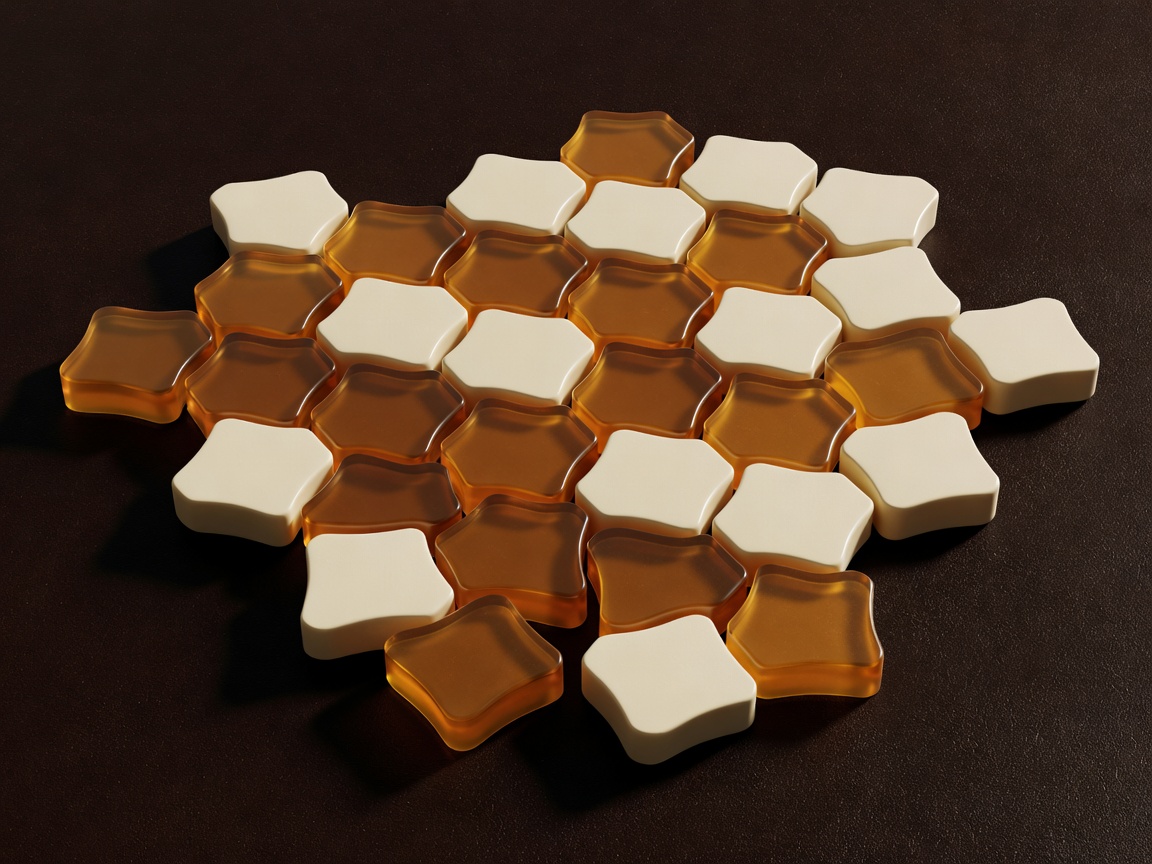
Hat tiles in a non-repeating patch. Amber tiles are mirror-image copies, which the hat needs and the spectre does not.
Construction notes
Make an Escher-style translation tile
- Start with a paper square.
- Cut any curve from the left edge and tape it to the right edge without rotating it.
- Do the same from the bottom edge to the top edge.
- Trace the new shape repeatedly, sliding it in rows. Then decide what creature it resembles.
Why a hat tiling can’t be periodic, in short
Hat tiles are forced to group into larger clusters that behave like bigger tiles, which group again, without end. A periodic pattern would need one finite block that repeats; this endless hierarchy rules that out.
Quick check for any polygon
Any triangle and any quadrilateral, even irregular and non-convex ones, can tile the plane. Rotate copies 180° about edge midpoints and their angles always close a full turn.