Build a Form That Breaks Space
Three straight beams. Each meets the next at a right angle. Together they close into a triangle that no workshop on Earth could weld. The rule: every local junction is legal; only the global loop is not.
Local truth, global lie
Cover two corners of a Penrose triangle with your hands and the remaining corner is a perfectly ordinary bend in a square beam. Move your hands and the same is true of every corner. The contradiction lives nowhere in particular; it appears only when you follow the whole loop.
Swedish artist Oscar Reutersvärd drew the first known version in 1934, as a ring of stacked cubes. Psychiatrist Lionel Penrose and his son, mathematician Roger Penrose, independently arrived at the continuous-beam form and published it, together with the endless staircase, in a 1958 paper in the British Journal of Psychology titled “Impossible Objects: A Special Type of Visual Illusion”. M.C. Escher took both ideas further in Belvedere (1958), Ascending and Descending (1960) and Waterfall (1961).
In 1992 Roger Penrose showed that the impossibility can be described precisely using a branch of topology called cohomology. In plain terms: the depth relations you read at each corner cannot be stitched into one consistent set of distances.
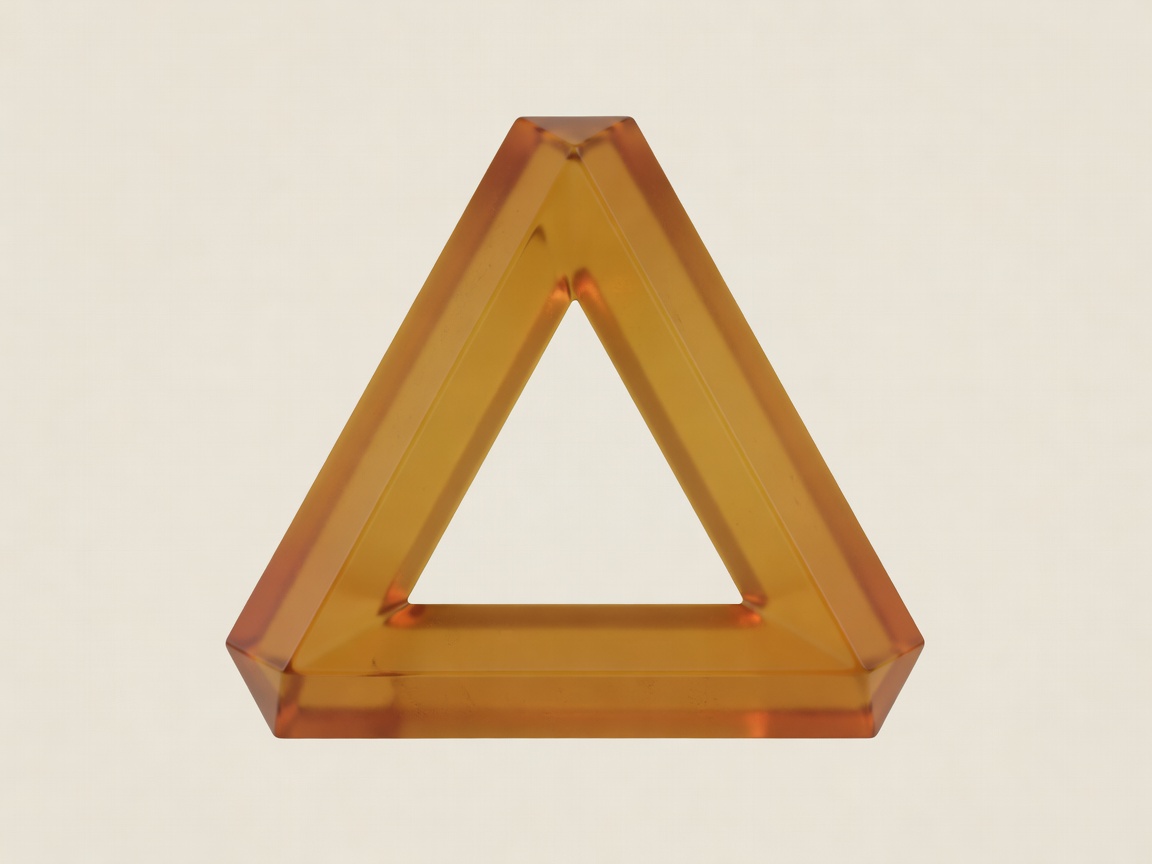
A physical model photographed from its one working viewpoint. The drawn figure is impossible; this object is not.
- Top-left corner: honest right angle.
- Lower-right junction: two beams that only overlap in the picture.
Genuinely impossible or just well placed?
These two families are often mixed up. A drawing can be truly impossible; a physical object never can. Real objects that look impossible are always using a hidden gap, a curved edge or a single fixed viewpoint.
| Example | Category | How it works |
|---|---|---|
| Penrose triangle (drawing) | Genuinely impossible | No arrangement of straight beams in 3D space produces these exact junctions. |
| Penrose stairs (drawing) | Genuinely impossible | Each step rises, yet the loop returns to its start. |
| Impossible trident, or “blivet” | Genuinely impossible | Line endings switch between round prongs and flat bars mid-figure. |
| Impossible-triangle sculpture, East Perth, Western Australia | Perspective trick | A real structure that aligns only from one viewing spot. |
| Ames room (Adelbert Ames Jr., 1946) | Perspective trick | A distorted trapezoid room seen through a peephole looks rectangular. |
| Kokichi Sugihara’s “impossible motion” models | Ambiguous real object | Shapes designed so a mirror shows two contradictory readings; winner of the Best Illusion of the Year contest in 2010. |
Forced perspective: making the impossible stand
A camera, like a single eye, loses depth. Two objects at very different distances can line up in the image as if they touched. Forced perspective exploits exactly this. Build a beam that stops short, place the next beam far behind it, and from the right spot the ends meet.
The Ames room uses the same principle on a larger scale. One corner is much further from the viewer than the other, but the walls, floor tiles and windows are skewed so the room still looks like an ordinary box. People walking across it appear to grow and shrink.
The giveaway is always movement. Take one step sideways and a genuine object stays coherent while a forced-perspective build falls apart. That is why these works are usually shown through peepholes, fixed camera positions or marked floor spots.
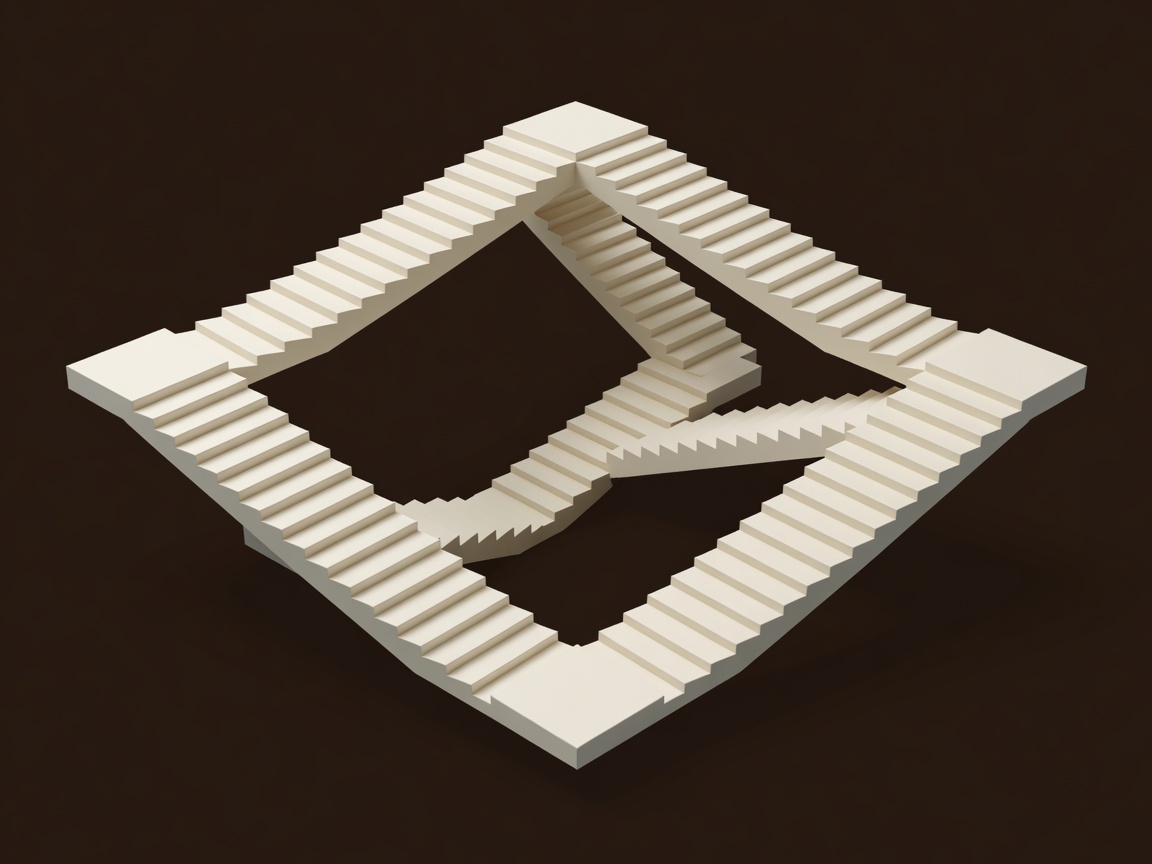
An endless-staircase model. The highest and lowest steps are far apart in depth but overlap in the frame.
Construction notes
Draw a Penrose triangle in six steps
- Draw a small equilateral triangle.
- Extend each side outward by the same length, turning the same direction each time.
- From each extended end, draw a line parallel to the next side.
- Repeat once more to form the outer edge.
- Close the three outer corners.
- Shade the three visible faces in light, medium and dark.
Build a one-viewpoint model
Make an L-shape from two card beams and a third beam on its own. Fix your phone camera on a stand. Move the loose beam back and forward until its end visually meets the open end of the L, then mark that camera position. Every photo from that spot shows an impossible triangle.
Spot a perspective trick in a photo
Look for shading that doesn’t match where surfaces should meet, background lines that run behind a “joint”, and a suspiciously centred viewpoint.